 High Bay LED Lighting
 Industrial Low Bay Lighting
 Industrial Strip Lights
 Vapor Tight Lighting
 LED Shop Lights
 LED Ready Fixtures
 Hazardous Area / Explosion Proof Lighting
 Loading Dock Lights
 Construction / Portable Lighting
 High Temperature LED Lights
 Industrial Ceiling Fans
 LED Work Lights
 Networked Controlled Lighting
 American Made Industrial Lighting
 Clearance
 Troffer Lights
 LED Flat Panel Lights
 Drop Ceiling Lights
 LED Ready Troffers
 Suspended LED Lights
 LED Cylinder Lights
 Stairway & Corridor Lighting
 Hospital Bed Lights
 Wrap Lighting Fixtures
 Gooseneck and Barn Lights
 Commercial Sign Lights
 LED Track Lighting Fixtures & Systems
 Recessed Lighting
 Wafer Lighting
 RGB LED Lights
 Exit / Emergency
 Refrigeration Lighting
 Grow Lights
 UV Disinfecting Lights & Air Purifier Fixtures
 American Made Commercial Lighting
 LED Flood Lights
 Outdoor Wall Lights
 LED Area Lights
 Parking Lot Lights & Poles
 Outdoor Post Top Lights
 LED Stadium Lighting
 Canopy Lights
 Security & Motion Sensor Lights
 LED Bollard Lights
 Outdoor Barn Lights
 Solar Powered LED Lighting
 Dusk to Dawn Lights
 Landscape Lighting
 Outdoor String Lights
 Coastal Wildlife Lighting
 Outdoor House Lights
 American Made Outdoor Lighting
 Architectural Linear Lights
 Architectural Grid Mount Lights
 Architectural Round Pendant Lights
 Architectural Square Linear Lights
 Architectural X-Shaped Linear Lights
 Architectural LED Wall Packs
 Ceiling Fans
 Ceiling Lights
 Chandelier Lights
 Pendant Lighting
 Island Lights
 Under Cabinet Lighting
 Vanity Lights
 Wall Sconces
 LED Tape Lights
 LED Mirrors
 LED Light Bulbs
 LED Tube Lights
 LED Corn Lights
 Vintage LED Bulbs
 Decorative LED Bulbs
 Fluorescent Light Bulbs
 Metal Halide Lamps
 LED Magnetic Strip Retrofit Kits
 LED Strip Light Retrofit Kits
 High Bay LED Retrofit Kits
 LED Troffer Retrofit Kits
 LED Wall Pack Retrofit
 LED Street Light Retrofit Kits
 Recessed Lighting LED Retrofit Kits
 WareSense Blue - Bluetooth Control System
 Ballasts & Drivers
 Emergency Ballast For LED & Fluorescent Lights
 Electrical Supplies & Mounting Kits
 Electrical Tools
 Switches & Receptacles
 Electrical Power Cords
 Sensors and Timers
 Smart Home Automation
 High Bay Occupancy Sensors
 Electric Vehicle Chargers
 Hand Dryers
 LED Shop Lights
 Garage LED Lighting
 Gym Lighting
 Factory Lights
 Restaurant Lights
 Office Lights
 Classroom Lights
 Church Lights
 Warehouse Lights
 Hospital Lights
 Walkway Lights
 Parking Lot Lights
 Exterior Building Lights
 Sports Lighting
 Airport Lights
 NSF Rated Lights
 TAA LED Lighting
 Corridor Lights
 Barn Lighting
 Multi-Family Lighting Solutions



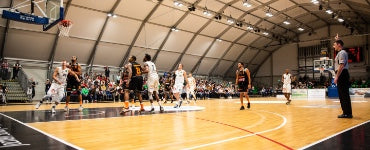
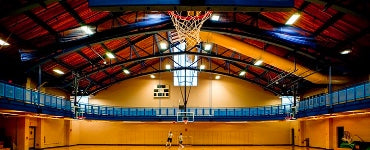
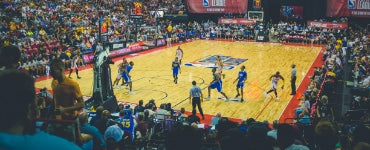
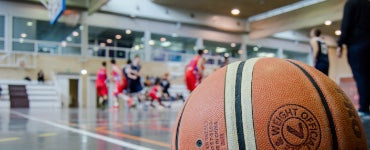
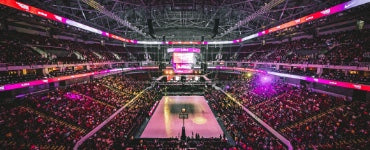
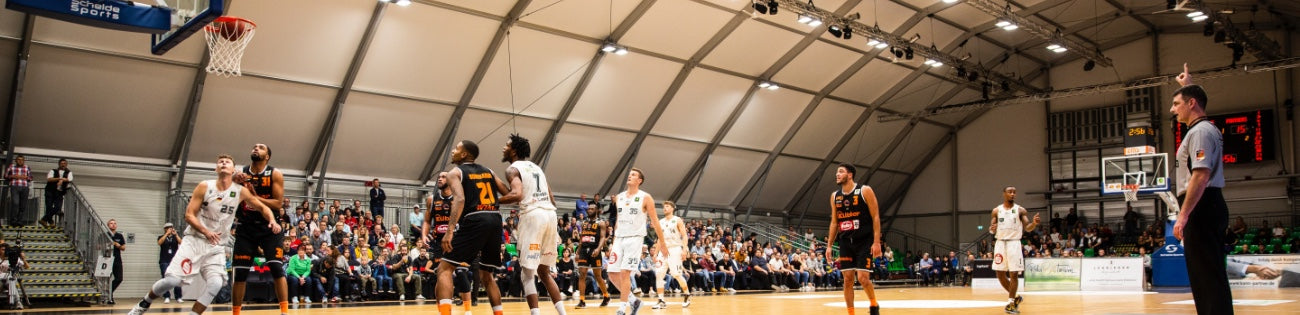
1. Balance Intensity with Visual Comfort
While visibility is the priority, "more" isn't always "better." Choosing the correct lumen output (often associated with wattage) ensures the court is bright without being blinding.
The Goal: Aim for high uniformity—where the light is spread evenly across the floor.
The Standard: For indoor courts, horizontal light levels typically range from 20–30 footcandles for backyard and casual recreational play up to 150–200 footcandles for professional broadcast venues. See the full breakdown by level of play below.
2. Prioritize Glare Reduction (Low UGR)
Indoor basketball courts often feature high-gloss hardwood floors. Without the right fixtures, these floors act like mirrors, creating dangerous "hot spots" of glare.
The Solution: Use LED high bays specifically designed with glare-reducing shields or frosted lenses.
The Advantage: Modern LEDs have a lower Unified Glare Rating (UGR). Instead of one concentrated point of light, they distribute lumens evenly, preventing players from being "blinded" when they look up for a rebound.
Choosing basketball stadium lights with glare reduction shields is your best bet for proper lighting. The type of light fixture you use also plays a significant role in reducing glare – sport lights and floodlights are some of the most commonly used options. To get the most out of your basketball arena lights, we recommend choosing LED high bay options. LED lights have a lower glare against glossy finishes because they spread lumens more evenly against different surfaces rather than in one concentrated output like other types of lighting. You can browse fixtures selected for this application in our basketball court light fixtures collection.
3. Optimize Fixture Placement for Uniformity
To keep the field of play clear, avoid placing lights directly over the baskets or in the primary line of sight for shooters. The Strategy: Position fixtures so that the most concentrated beams fall just outside the main field of play. The "outer cast" or spill of the light should be what illuminates the court. This creates a soft, even glow that eliminates harsh shadows under the hoop.
4. Select High Color Rendering (CRI)
Color matters. To ensure the lines on the court, the jersey colors, and the ball are easily distinguishable, you need a high Color Rendering Index (CRI). Tone: Opt for "Cool White" or "Daylight" temperatures (around 5000K). LED vs. Old Tech: While Metal Halide was once the standard, it often has a CRI of 60 or lower. Modern LEDs boast a CRI of 80 or 90, making the action look more vivid for both the live audience and photographers.
5. Maximize Energy Efficiency with LED
Operating a sports facility is expensive. Switching from traditional Metal Halide or High-Pressure Sodium to LED can reduce your energy consumption by 50% to 70%. Efficacy: High-quality LEDs offer roughly 140–160 lumens per watt. Instant On: Unlike older bulbs that require a 15-minute "warm-up" period, LEDs turn on instantly, allowing you to manage lighting schedules more effectively.
6. Understand Light Levels for Different Tiers
The most important number in any basketball court lighting design is the maintained horizontal illuminance across the playing surface. In the United States this is usually specified in footcandles (fc); most international guidance uses lux. The two are directly convertible: 1 footcandle ≈ 10.76 lux. Requirements are not a simple televised-or-not choice — they scale across five tiers of play, and the higher tiers add uniformity and vertical illuminance requirements on top of the raw light level.
Shop Basketball Lighting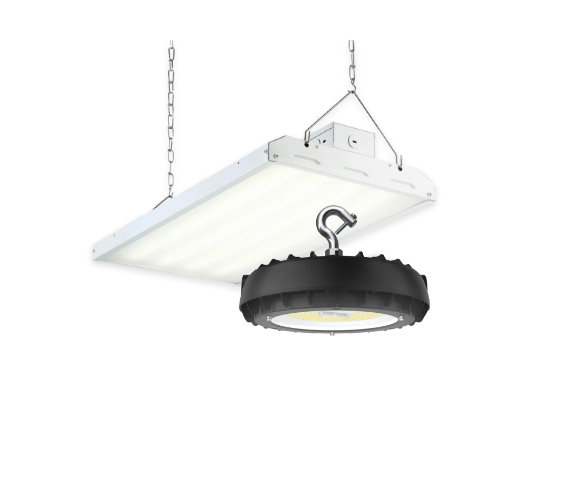
Basketball Court Lighting Requirements by Level of Play
The table below shows typical design targets for indoor basketball courts. Use it as a starting point for a photometric layout, then confirm against the standard that governs your facility — IES RP-6 for most North American projects, FIBA lighting guidance for sanctioned international competition, or your conference or league specification for collegiate and professional venues.
| Level of Play | Maintained Light Level | Uniformity (max:min) | Typical Use |
|---|---|---|---|
| Backyard or driveway court | 20–30 fc (200–300 lux) | 3:1 | Casual play and safety |
| Recreation center or church gym | 30–50 fc (300–500 lux) | 3:1 | Multipurpose use, league practice, youth play |
| High school competition | 50 fc (≈500 lux) | 2.5:1 | Spectator seating, no broadcast |
| Collegiate and semi-professional | 50–75 fc (500–750 lux) | 2:1 | High-speed competitive play, local streaming |
| Professional and televised | 150–200 fc (1,500–2,000 lux) | 1.5:1 | Broadcast cameras and slow-motion replay |
Non-Televised Courts: Recreational Through Collegiate
For the vast majority of courts, the target sits between 30 and 75 footcandles (roughly 300 to 750 lux). A regulation NBA and NCAA court measures 94 by 50 feet; a high school court is typically 84 by 50 feet. Because illuminance describes light landing on a surface rather than total output, the court's area does not change the footcandle target — it changes how many fixtures and what wattage you need to hit that target evenly. That is what a photometric layout is for.
Uniformity matters as much as the raw number. A court averaging 50 footcandles with bright pools under each fixture and dim gaps between them plays worse than a court averaging 35 footcandles laid out evenly, because players' eyes constantly readjust as they move.
Televised and Broadcast Courts
Broadcast venues are a different design problem. Horizontal illuminance climbs to roughly 1,500–2,000 lux (150–200 fc), but the binding requirement is usually vertical illuminance — the light falling on players' faces and torsos as seen from each camera position. High-frame-rate and 4K broadcast also tighten uniformity and flicker tolerances well beyond what recreational play requires. If your facility will be televised or professionally streamed, the layout should be designed around camera positions from the start.
7. Professional Basketball Arena Lights Must be Flicker-Free
If your games are televised or live-streamed, "flicker-free" lighting is non-negotiable. Standard lights may appear to strobe when captured by high-speed cameras used for slow-motion replays. The Spec: Professional sports LEDs should support high frame rates (up to 6,000 FPS) with a flicker rate of less than 0.3%. This ensures that the digital broadcast remains smooth and professional.
Basketball Court Lighting FAQs
How many lumens does a basketball court need?
Lumens measure what a fixture emits; footcandles and lux measure what actually lands on the floor, and that is what the standards specify. Working backward from a target, a regulation 94 by 50 foot court at 50 footcandles needs roughly 300,000 to 350,000 total fixture lumens once you allow for mounting height, fixture spacing and surface reflectance. In practice that usually means 12 to 16 high bays in the 25,000 to 30,000 lumen range. Ceiling height, wall and ceiling color, and beam distribution all move that figure, so treat it as a planning estimate rather than a specification — a photometric layout is what confirms it.
How high should basketball court lights be mounted?
Above the clear-play zone, and never below the minimum ceiling height your governing body requires. For high school competition that figure is commonly cited around 25 feet, so confirm it against your state association's rule book before finalizing a layout. Most competition gyms mount fixtures flush to a ceiling somewhere between 22 and 30 feet.
Mounting height also drives beam selection. Above roughly 25 feet, narrower distributions of 60 degrees or less keep light on the court instead of washing the walls. Below about 20 feet, wider distributions or linear and low bay fixtures avoid the hot-spot-and-shadow pattern that narrow beams produce at short throws. Any fixture within reach of play should have an impact-resistant lens or a wire guard, and nothing should sit directly above a backboard.
What color temperature is best for basketball court lighting?
4000K to 5000K covers almost every court. 5000K reads crisp and daylight-like, helps players track a fast-moving ball, and films and photographs well, which is why it is the common specification for competition gyms. 4000K is slightly warmer and often preferred in multipurpose facilities that also host banquets, graduations or worship services. Above about 5700K the light starts to read harsh and clinical and is rarely worth specifying.
Pair whichever you choose with a CRI of 80 or higher, and 90 or higher if the space will be filmed or photographed regularly. If the gym genuinely serves several purposes, CCT-selectable fixtures let you set the color temperature at install rather than committing to it at the point of order.
Ready to Light Up Your Court?
Getting your lighting right requires a balance of physics and high-quality hardware. At Warehouse-Lighting.com, we provide professional-grade consultations and photometrics to ensure your court meets every safety and broadcast standard. Browse our basketball court light fixtures, or contact us today for your consultation.
Find Basketball Arena Lights at Warehouse-Lighting.com
Warehouse-Lighting.com can take your basketball court lighting to a new level. Our basketball lighting products are highly specialized for use in professional or recreational applications. Browse our entire selection today.
Shop Basketball LightingRelated Sports Lighting Guides
When it comes to lighting, the right fixtures and solutions will depend on the location itself. For a location as unique as a racetrack, the lighting needs to meet specific requirements.
When it comes to finding the right lighting solutions, every location has its own unique considerations.
Lighting should always be tailored to the location. With tennis court lighting, there are certain factors that are unique to the location which will determine the appropriate solutions.

CondorX Premium 2FT LED Linear High Bay, 24,640 Lumen Max, Wattage and CCT Selectable, 120-277V, Sensor Ready

CondorX Premium 2FT LED Linear High Bay, 31,200 Lumen Max, Wattage and CCT Selectable, 120-277V, Sensor Ready

Aries G6 LED UFO High Bay, 22,500 Lumen Max, Wattage, CCT, and Optic Selectable, Black Finish, Comparable to 320-400 Watt HID Fixture, 120-277V

Aries G5 LED UFO High Bay, 22,500 Lumen Max, Wattage, CCT, and Optic Selectable, White Finish, Comparable to 320-400 Watt HID Fixture, 120-277V

Shop High Bay LED Lights from Warehouse-Lighting.com. Our High Bay LED Lights offer superior illumination and efficiency, perfect for large industrial spaces.
View (267) Products
LED low bay lights for ceilings under 20 feet. Troffer, round UFO and retrofit options with free layout assistance on commercial projects.
View (40) Products
For the best selection of industrial strip lights online, look no further than Warehouse-Lighting.com. From staggered to shop light strips, our products provide powerful lighting solutions for your unique needs. Shop for commercial-grade strip light fixtures today!
View (83) Products

